


How to A/B Test Your Landing Page (Even If You're Not a Marketer)
A/B testing sounds technical but the basics are simple. A practical guide to running tests that actually tell you something, even without a marketing team.

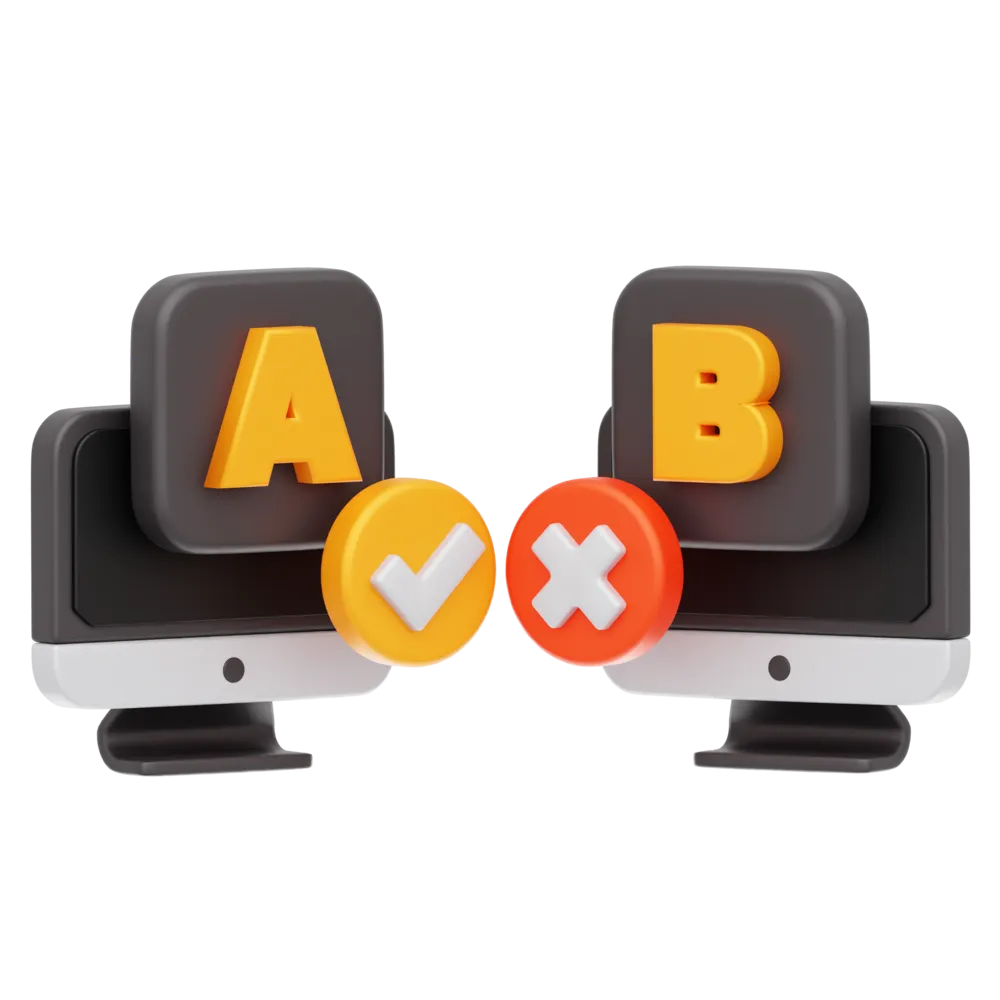
A/B testing has a reputation for being more complicated than it is. The marketing world wraps it in statistical jargon, talks about confidence intervals and Bayesian inference, and recommends expensive tools with intimidating dashboards. The result? Most people who would benefit from A/B testing never start.
The honest truth is that the basic version of A/B testing is straightforward:
- You have one version of your page.
- You make a different version.
- You show each version to half your visitors.
- You see which one performs better.
The math involved is simpler than splitting a restaurant bill.
This guide is the practical version. It covers what to test, how to set it up without a data science degree, what counts as a meaningful result, and the mistakes to avoid. By the end, you will be able to run a useful test on your own page within a week.
What A/B Testing Actually Tells You
The point of A/B testing is to answer one question: which version of this thing produces more of what I want?
You do not test to be scientific. You test because you have a hunch and want to know if it is right before committing to it. Your hunch might be that:
- A different headline would convert better
- Moving the CTA higher would increase clicks
- Removing a section would help focus
A/B testing lets you check the hunch with real data instead of guessing.
What A/B testing does NOT tell you
- Whether your page is "good." A test only compares two versions; both might be mediocre.
- Why one version won. The test shows what, not why. The why is your interpretation.
- Whether the result will hold over time. Results from short tests can shift as your audience changes or as the novelty effect wears off.
Knowing the limits keeps you from over-interpreting. A test that says "version B beat version A by 23 percent" does not mean version B is the answer. It means version B was better than version A, in this period, with this traffic, by this margin. That is useful information, but it is not the truth.
Before You Test Anything: Have Enough Traffic
The single most common mistake in A/B testing is running tests on pages that do not have enough traffic to produce meaningful results.
The rough rule of thumb
You need each version to receive at least 100 conversion events before the result starts to mean anything. If your conversion rate is 2 percent, that translates to:
- 5,000 visitors per version
- 10,000 total visitors per test
What this means for different traffic levels
| Monthly traffic | A/B testing advice |
|---|---|
| Under 500 visitors | Do not A/B test. Use principles-based optimization instead. |
| 500 to 5,000 visitors | Test only major changes you expect to produce big differences. |
| 5,000 to 50,000 visitors | You can run one focused test at a time. |
| 50,000+ visitors | You can run multiple tests and explore subtler variations. |
If your landing page gets 200 visitors a month, A/B testing it will not produce useful results. You will see fluctuations that look like signal but are actually noise. The honest answer for low-traffic pages is to focus on improvements based on principles (covered in our complete landing page best practices guide) rather than trying to test every change.
What to Test (And What Not to Test)
The biggest factor in whether your test produces a useful result is what you choose to test. Test the wrong thing and even a perfectly run test tells you nothing actionable.
✓ Test these (in rough order of impact)
1. Headlines The single highest-leverage element. Different headlines test different value propositions, which can produce dramatically different results. For guidance on what makes a strong headline in the first place, see what to put above the fold.
2. Calls to action Different CTA copy can produce 20 to 50 percent differences in click-through. Worth testing once your headline is solid. For more on what makes a CTA work, see how to write a call to action that people actually click.
3. Hero visual Product screenshot versus illustration versus video. Often produces meaningful differences.
4. Form length Three fields versus seven fields. Often a large effect, especially on lead generation pages.
5. Section order Especially whether proof comes before or after the value proposition.
6. Pricing presentation How prices are displayed (monthly versus annual default, comparison table versus tiered cards) can shift conversion meaningfully.
✗ Do not bother testing these
- Button color. Endless tests have shown that color rarely produces meaningful differences, while the testing distracts from things that do matter.
- Tiny copy variations. "Start your free trial" versus "Begin your free trial." The signal will be too small to detect with most traffic levels.
- Font choices. Within reason, font choice does not move conversion. Pick a readable one and move on.
- Layout micro-adjustments. Whether the spacing between sections is 60px or 80px is not worth a test.
The pattern: test things that change the underlying message or experience. Skip things that only change the surface.
Setting Up a Test
For most people, setting up an A/B test takes one of two paths.
Path 1: Use built-in tools in your platform
Some website builders include basic A/B testing natively. For block-based builders like Beste, the workflow is straightforward:
- Duplicate your page
- Modify one variable on the duplicate
- Use the platform's testing feature to split traffic
This is the simplest setup if your platform supports it. Check your platform's documentation for "A/B testing" or "split testing" features.
Path 2: Use a dedicated A/B testing tool
If your platform does not have native testing, several tools handle it well in 2026:
- PostHog offers solid A/B testing in its free tier
- VWO is a robust option with a generous starter plan
- Convert is straightforward for marketing teams
- Microsoft Clarity offers basic testing alongside its free session recordings
Most of these tools work by inserting a small script on your site that swaps content based on which test variant a visitor is assigned to. Setup typically takes about an hour for a first test, less for subsequent tests.
What you actually need to track
For each test, you need three things:
- The variant assignment: which version did each visitor see?
- The conversion event: did they take the action you wanted?
- Secondary metrics (optional): time on page, scroll depth, clicks on other elements
Critical: Define the conversion event before you start the test, not after. Common conversion events include form submission, button click leading to signup, or purchase completion. Whatever your goal is, that is your conversion event.

How Long to Run the Test
Run the test until you have enough data to trust the result. Two thresholds matter:
Minimum sample size
Each variant needs to receive at least 100 conversion events for the result to mean much. Lower than that and you are looking at noise.
Minimum duration
Even with high traffic, run the test for at least one full week. Visitor behavior varies by day of week, and a test that ends on a Wednesday might miss the weekend pattern. Two weeks is safer for most situations.
The practical implication: Do not check the test daily and stop it the first time one variant is ahead. Early results swing wildly, and stopping at the first lead almost always produces wrong conclusions.
A test that runs for 3 days and shows variant B winning by 40 percent is much weaker evidence than a test that runs for 14 days and shows variant B winning by 12 percent. The longer test with the smaller margin is the one to trust.
Reading the Results
Once your test has run for the right duration, you look at the numbers and decide whether to roll out the winner.
What "winning" actually means
Most A/B testing tools report a confidence level or probability that one variant is genuinely better than the other. The standard threshold is 95 percent confidence, meaning there is a 5 percent chance the difference is random noise.
In plain language: if your tool says "variant B is winning with 95 percent confidence," roughly speaking, if you ran this test 20 times, 19 of the runs would show B winning.
Below 95 percent, the result is suggestive but not strong. You can act on it if the cost of being wrong is low (rolling out a CTA copy change is low-risk). You should not act on it if the cost is high (replacing a key page based on a 70 percent confidence test is overconfident).
What to do with the result
If variant B clearly won at 95 percent confidence:
- Roll out variant B as the new default
- Move on to the next test, ideally testing something different (do not endlessly tweak the same element)
If neither variant clearly won (difference is within the noise):
- Keep the current version
- Test something more substantial next time
- The lack of difference is also useful information; it tells you that variable does not matter much for your audience
If variant B won but the test had issues (low traffic, only ran a few days, holiday week):
- Treat the result as a hypothesis, not a conclusion
- Re-run the test under cleaner conditions if the change matters
Common A/B Testing Mistakes
The patterns that wreck most tests:
1. Stopping too early
"Variant B is winning by 30 percent after three days, let's go with it."
Three-day results are usually noise. Run the full duration.
2. Testing too many things at once
If you change the headline AND the hero image AND the CTA all in variant B, you cannot tell which change produced the result. Test one variable per test.
3. Testing during weird periods
Running a test during a holiday week, a major news event affecting your industry, or a pricing promotion that changes visitor behavior produces results that do not generalize. Test under normal conditions.
4. Cherry-picking metrics
"Variant B had lower conversions but higher engagement, so let's call it a tie and pick the prettier one."
Pick your conversion metric before the test, evaluate against that metric, do not change the rules after.
5. Running too many tests at once
Running three tests on the same page simultaneously contaminates each test (visitors are seeing combinations of variants). Run tests sequentially or on different pages.
6. Not having a hypothesis
"Let's test these two random versions and see what happens" produces results you cannot learn from. Start with a hypothesis like:
"I think a benefit-focused headline will outperform a feature-focused one."
Test it. Learn from the result.
7. Testing forever
The point of testing is to make decisions and move on. A page that has been in continuous testing for a year has not been optimized; it has been frozen.
A Realistic Testing Cadence
For a typical landing page with moderate traffic, a sustainable testing rhythm looks like this:
| Month | Test | Duration |
|---|---|---|
| Month 1 | Test the headline. Two strong variants, one different value proposition. | 2 weeks |
| Month 2 | Implement the winner. Test the CTA copy or placement. | 2 weeks |
| Month 3 | Implement the winner. Test the hero visual or the order of sections. | 2 weeks |
| Month 4 | Implement the winner. Larger structural test, like a fundamentally different page layout. | 2+ weeks |
This pace produces real improvement over time without overwhelming you. Each test produces a clear yes/no, you learn something about your audience, and the page gets meaningfully better.
The trap: trying to test everything constantly. Pick the highest-leverage test, run it well, learn, move on.
What to Do If You Cannot Run Real A/B Tests
If your traffic is too low for proper A/B testing (less than a few thousand visitors per month), you are not stuck. You just have to use different methods.
The five-second test
Show the page to people who have not seen it before, hide it after five seconds, and ask what they remember. Reveals whether the message is landing.
Heatmaps and session recordings
Tools like Microsoft Clarity (free) show:
- Where visitors click
- How far they scroll
- Where they drop off
Often more useful than A/B tests for low-traffic pages because they reveal the underlying behavior, not just outcomes.
User interviews
Talk to ten visitors or potential customers about your page. Ask them:
- What does it say?
- What does it offer?
- What would you do next?
Painful but honest.
Principles-based optimization
Apply known patterns from research and case studies:
- Headline specificity
- Single primary CTA
These principles are well established and produce real improvements without requiring tests to validate them.
For a low-traffic page, two months of principles-based work plus user interviews will improve the page more than two months of underpowered A/B tests.